Sunday, November 9, 2008

Preparing fields for a long winter's nap

After nine beautiful fall days, most of the leaves have fallen and the fields are brown.

"What do you do in the winter?" is a frequently asked question. The first item on the list is to clean up vegetable gardens. We plant many of our crops through black plastic mulch. This warms the soil, controls weeds, preserves moisture, and protects plants from soil-born disease. Under the plastic mulch is trickle irrigation hose, which places water only in the root zone, not into the air as in overhead irrigation. Using these plastics is very helpful. However, they must be removed from the fields every year. Our tomatoes are staked and trellised, so those fields have additional materials to remove.

This work is labor intensive. First, strings must be cut at each stake and yanked out of the plants. Then the wooden stakes must be pulled out of the ground. String is bagged and discarded. We pile the stakes on a wagon, sorting 4-foot lengths for next year's tomatoes and broken ones for deer fence. The brushhog chops off plants just above ground level. Then the plastic must be lifted and rolled. Finally, the drip hose is pulled.Fields are ready to be disked and planted with rye. Rye is a cover crop which prevents soil erosion by wind and water throughout the winter, and adds organic matter to the soil when it is plowed under in the spring.

Penn State is studying ways to recycle ag plastic. We would have to haul it 500 miles to a collection site, which is not practical. So our used plastic is collected by our garbage hauler.


Monday, November 3, 2008

ANNOUNCING...a new product

On September 24, 2008, Lily Ann was born, making Phil and Becky grandparents for the first time. Making trips to witness the birth and assist first-time parents has left less time for farming and no time for posting new blog entries. We have priorities! She is a healthy, happy, beautiful baby, and we are blessed to have her as our granddaughter.

The market on the farm is closed since October 18. The last day for the Coraopolis market was October 27. We continue to offer veggies at Ambridge on Thursdays, 3:30pm - dusk, and at Beaver on Saturdays, 10:00am - 1:00pm. The only items left are:
WINTER SQUASH-acorn, festival, spaghetti, buttercup, LaEstrella, GA Bulldog...photos of some of these can be seen in the post of October 9, 2007...others are identified belowSquash identified from left to right: striped pumpkin contains hull-less or naked seeds, One Too Many(sold out)-lacey orange skin, GA Bulldog-bright orange skin, LaEstrella-striped, Long Island Cheese, neck pumpkin, Red Warty Thing

RED CABBAGE
HERBS-Cutting Celery (Parcel), Oregano, Sage (front and center of picture below)...these herbs are quite hardy and are still fresh-cut despite several frosts
HARDSHELL GOURDS- Apple and swan...decorative only, not edible, very nice for Thanksgiving and/or Christmas...can be dried, then painted or etched

Other farmers at the market offer apples, cider, potatoes, cabbage, beets, broccoli, greens, etc. Visit one of the markets and you will find quite an assortment of fresh, locally grown products.

Saturday, September 13, 2008

Rain...thank goodness!

Finally another post!
The tomatoes are ripe.
We've been busy picking, washing, sorting, packing and selling peppers and tomatoes.


Rain has blessed the parched earth...3-1/2 inches worth!
While the girls worked Ambridge Farmers' Market on Thursday afternoon, Phil picked tomatoes. And it's a good thing he did, because the rain began early Friday morning, continuing much of the day. Phil & Becky picked peppers and eggplant in the rain, leaving the field only when it became impossible to walk on the soggy ground. On Saturday morning, in a gentle drizzle, we harvested cabbage, broccoli and basil. We headed to the Beaver Farmers' Market at 9am. Around 10:15am, the rain fell harder, but our loyal customers continued to shop.

Throughout much of July and August, the vegetable gardens have been irrigated. Since the drought of 1988, we use drip irrigation under black plastic mulch on all our crops except corn and beans. This method places the water at the roots of the crop, and uses about half of the water needed for overhead irrigation. One planting of sweet corn has already been lost to the drought. So we are experimenting with drip irrigation on the later plantings.
On Thursday afternoon August 21, Phil laid drip irrigation lines along part of the rows of corn. After only 8 hours of irrigation, the effect was dramatic, as seen below. Foreground is unirrigated and background toward the tractor is irrigated.

The following pictures show how the drip line is supplied with water.
We decided to irrigate the entire field. It has been watered on a weekly basis since then. It seems that every time we irrigate the corn, we also get rain. Harvest is expected to begin on September 24.

Sunday, August 10, 2008

GET RIPE ALREADY!!!

Well here it is August 10th and still no ripe tomatoes.
We are harvesting peppers, zucchini, cabbage, onions, sweet corn, herbs, cucumbers ( almost done), and still a little lettuce. But no tomatoes yet. To paraphrase an old song "Yes we have no tomatoes, we have no tomatoes today." In case you haven't noticed we are wishing and hoping the tomatoes would ripen.
But we've been busy....
Our 3000 tomato plants have wooden stakes every other plant. String is woven on both sides of the plants and wrapped around the stake every 9-12 inches. The tomatoes do not touch the ground, keeping them clean and free of disease. Much of this work has been done in July, but some plants will get a fourth string this month.

After a very wet end of June (3.65 inches 6/26 to 6/30), dry weather finally arrived. From July 10-19, over 600 bales of hay were stacked in the barn.

On July 8, Phil planted Sweeter 'N Honey, a sorghum/sudan grass hybrid, as a summer cover crop.
First, he disked the field.


Then, he cleaned out the Ontario grain drill to plant the seed.


In 5 days, the field was a faint green, indicating the sprouted seed.


In 2 weeks, the grass had grown about 8 inches. By August 2, it was above my knees. This is being grown on a field not used for vegetables this year. It will be plowed under to add organic matter to the soil. Rye, another cover crop, will be planted this fall, to protect the soil through the winter.

We've been trying to keep ahead of the bugs and weeds. For about 2 weeks, Becky spent 2 hours a day removing Japanese beetles from the basil, eggplant, roses and hibiscus, all of which are especially favored by those bugs. When they could be counted, from 200 - 300 beetles were removed from a single trip out and back the row of eggplant! Anyone who shows up at the farm to work was sent to hoe weeds. At Douds Floyd Farm, it isn't enough to pull weeds; if you are working with Phil, you will also learn the names of the weeds.

Back to the old grindstone...

Sunday, July 6, 2008

A few words about our lettuces

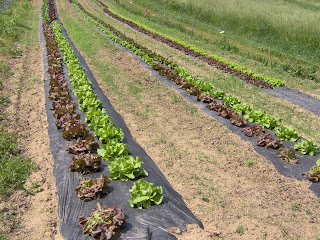
We grow five types of lettuce Lactuca sativa, red and green of each type. To produce lettuce continuously, we make successive plantings of nearly 500 plants each. Lettuce I was planted in the flower garden, because the field pictured below was not ready. Pictured below are two rows of Lettuce II, in the background, which are presently being harvested. Lettuce III (middle) will be ready soon. Lettuce IV (foreground) was field planted on July 1.

Coastal Star (green romaine) and Outredgeous (red romaine), also known as cos, has thick, crisp, juicy leaves with sweetness unmatched, according to Johnny's Seeds www.johnnyseeds.com


Saladbowl (green oakleaf lettuce) and Red Saladbowl (red oakleaf lettuce) has delicate, tender lobed leaves.


New Red Fire (red leaf lettuce) and Two Star (green leaf lettuce)


Sylvesta (green bibb lettuce) and Red Cross (red bibb lettuce), also known as Boston or butterhead, has large ruffly outer leaves surrounding a soft folded and blanched heart.


Nevada (green) and Magenta (red) Batavia lettuce, also known as French crisp or summer crisp has very crisp leaves that are sweet and juicy.


ENDIVE...coming soon!

Your comments please:
  • What is your favorite lettuce?
  • Your description of the taste of one of our lettuces.
  • Share a recipe.

Wednesday, July 2, 2008

Summary of June: RAIN

It has been raining, raining, raining off and on through the month of June.  About 3 inches of rain came in the storms over the past weekend.  It's been wet and muddy, and difficult to get into the fields.  Mom has been taking lettuce into market three days a week.  The earliest planting of lettuce is picked clean.  The weeds are flourishing with the rain.  Even if we pulled them they would be able to keep on growing because the roots can't dry out. 

Before the major rains, we did get a lot planted: zucchini, pumpkins (pictured above), cabbage, and more lettuce.  Check out this snapshot from Google maps that I have labeled with crop locations.

The first set of string is set up on the tomato patch (though this picture just shows the stakes set up) and the plants are beginning to blossom and set fruit.  Dad has run irrigation lines to the fields, but only had to run water a couple times.  The excess rain has prevented him from adding fertilizer and nutrients to the field through the irrigation water, besides keeping him from doing some additional planting and tilling.  He says he won't complain about too much rain, though.  It doesn't do any good and there are other places experiencing drought.  Besides that, sometimes with rain comes the beauty of a rainbow.

Monday, June 9, 2008

Summer begins in earnest!

After the cold and damp spring, the recent heat wave has felt like a blast furnace. I've been inside in a cushy air-conditioned office job while everyone else has been doing the work. The seedlings were moved out of the greenhouse about a week and a half ago, to harden them up and slow them down. Some of them were getting very tall and overgrown for their soil pots. (Here's what needs to be planted next: cabbage, basil, zucchini, cucumbers, and more.)
Last Monday, Roger, dad, and mom got plastic mulch laid. Dad and Roger drove the tractors while mom followed on foot keeping the plastic on track, letting them know if irrigation tape ran out, and starting and ending rows of mulch. The plastic was for the peppers, tomatoes, and most of the lettuce ... about 1.25 miles, which mom walked twice! On Tuesday, they planted the second patch of lettuce with 10 different varieties, nearly 500 plants. (Here's the lettuce, with the tomatoes beyond.) It was sprinkling the whole time, but not really raining. Next they planted tomatoes--1,800 plants. After mom and dad did the first 3 rows Aunt Laurie helped with the rest, 9 more rows. Thunder cracked just as they finished, and rain poured down. From Tuesday 3pm until Thursday noon we received nearly 2 inches.

Wednesday they did lots of work in the greenhouse: planted seeds for the late cole crop, transplanted late tomatoes, planted pumpkin and winter squash seeds, transplanted yet another planting of lettuce, and moved most of the remaining plants outdoors. (Here's the squash and pumpkins just beginning to sprout in the greenhouse.)
Saturday morning I finally was around when planting was going on and we got all of the peppers and eggplant in. Roger drove the tractor, mom and I rode, and dad walked behind to fix the ones we miss. We got the 4,000 peppers planted in about 4 1/2 hours. (Here's a row of eggplant with pepper rows on either side.) The planting itself took less time than driving back to the greenhouse for more plants and filling the planter with water. It was plenty hot by the time we were done, but so far they seem to be doing well and have not died from shock.

Today, mom went to Coraopolis market with lettuce. (Here's the lettuce in the field--nearly ready to be picked.) It was the first market of the year, and sure was hot for her in town.
Today dad told me that there are different ways to mark summer--the summer solstice on June 21st is the one most people know, but there is also the meteorological summer which has already begun, and another designation of summer that I can't remember at the moment. For me, though, summer is when it's still light and warm at 9pm, when markets begin, and when we eat the first produce from the garden. Happy summer, everyone!
Note to family: If you experienced deja vu while reading this blog, it's because I edited mom's email from earlier this week for much of this update.